Guitar Lessons by Chip McDonald - chip@chipmcdonald.com: Evans Georgia
Showing posts with label Evans Georgia. Show all posts

Sunday, November 13, 2022

Reverb is the Starfield of Music?

  This blog isn't always about guitar lessons.   Stand by for a very abstract post.....


 "Reverb is the Starfield of Music"


Or so I claim.

In science fiction movies, the starfield sets the tone.  

 In 2001: a Space Odyssey, it's understated.  The stars are not too bright, colorful or lurid.  They don't move.  You don't see them zooming by out if a porthole.  

Realistic.  

As the backdrop to the 2nd act of the movie, it defines what the movie sets out to do at that point: pull you in by trying not to defeat the illusion of "real".  In less realistic movies, maybe sci-fi shows from before the 90s, you had bright stars flying past a window on a starship: all the same color, same size.  Not as realistic, BUT - perhaps within the "creative universe" of said show.   Both a budget-restricted pragmatic choice, but maybe also a simple, quick way of communicating "you're in a starship traveling in a direction".

 Likewise, reverb on recordings once was based solely on analog gear, not unlike the analog "practical" effects of science fiction movies of yesteryear.   While the gear was primitive - springs, sheet metal plates, empty rooms with tiled walls - there was no Uncanny Valley to cross.   

 But just like the early days of computer graphics in movies, when digital came into recording it wasn't necessarily convincing.  Like early CG science fiction effects, you knew it kind of represented something but wasn't perfectly realistic.   It was good enough, and again, a pragmatic solution to production.

 Some music in the 80s suffers from this, although some just wallows in Artificial Modulated Reverb.  The early Sting recordings come to mind, Queensryche's _Operation Mind Crime_, some others.   Like the starship Enterprise in _Star Trek: the Next Generation_, something BIG was doing SOMETHING in a BIG SPACE.   You knew it wasn't real, but it was its own art form in a sense.   

  Post 80s bands started wanting real drum sounds in actual rooms, and for awhile Big Room Sounds supplanted the artifice of Lexicon digital reverbs.  Similarly, science fiction movies have started to reject the early efforts of George Lucas to use digital technology to "enhance" (ahem..) classic movies.   For some movies the look and feel *was* "computer graphics" (Tron, Terminator 2, the Abyss, et al) but when it was mixed in after the fact, the contrast wrecked the production.

 Recordings, being cheaper and much more common by orders of magnitude, have gone through this iteration already.  The Bricastic hardware digital reverb, digital convolution reverbs, have started pulling recording out of the Uncanny Valley somewhat, but some recordings are still prone to having peculiar combinations of "spaces" that are incongruent.  

 Just as some sci-fi movies feature a lot of exterior special effects, that "place" you in that world, others are more careful and spartan with the use of depicting space.   On recordings, the same thing occurs: the reverb tone, sound, and amount is the backdrop for a recording.   


Thursday, February 18, 2021

Lead Guitar Tips from.. The Tech Lead?

 Hello, The Guitar Teacher here.


(...that's a contextually funny in joke, trust me)

 I believe there is some kinesthetic overlap between typing and guitar playing.  

 When you touch type you're using sublimated muscle memory to press something that represents an alphanumeric character. You don't think about the act of pressing the key, the key representing an alphanumeric character, the character being part of a "word", the word being something you have to consciously spell before your type it out, the word part of a sentence, sentence structure, paragraphs, composition.   

 You touch type (hopefully) from a stream of consciousness, controlling your thinking between the immediate future - your buffer memory, and a more "distant future" of your compositional sense, how what you're typing relates to your overall intent.  

  In my opinion, guitar playing should be this way.  You shouldn't be thinking "I need to put my finger "there" to make the note "D" sound".  "D is part of the D diatonic scale, which is part of a D major triad consisting of D, F# and A, and that's a subset of diatonic harmony," etc. etc. etc..  It should be a reflex if you really want to "speak" when improvising.  You don't speak to other people the way you would write a book, would you?  


In my opinion.  Most people appear to be deciding to consciously do high order math in order to justify their note choices.  That is what I would call an "approach" to process, but different from what I choose to do.  Instinctual choice I think is the point of improvising.  Constructing "sentences" and "paragraphs" from extemporaneous thought, versus pre-planning.  

 Back to typing:

  In the 90s I had my typing speed up over 100 words per minute.  Sometimes I could get it up to a 1:1 or faster speed at an "average speaking voice" tempo, but it's nowhere near that now.  The guy in this video - an ex-Google, ex-Facebook programmer, types at 170 wps - which is very fast, "guitar hero" speed.  I would attribute that to an alpha actinin-3 gene polymorphism (as I've referenced in prior posts), but it mostly down to some simple tips he references within his video.   

 Some of which applies to playing guitar.  Ergonomic positioning, keyboard switches, pitch.  The most important tip being: "don't go faster than you can type perfectly".  I've harped on that before; speed is easy if you're willing to practice something at an optimal tempo perfectly.  You can't do that and not get faster.  Speed is easy. It's very straightforward.

 But watch Techlead's video.  He has a very "technical guitar" approach to typing, that can be motivational I think to practicing guitar (choosing the proper gear, mechanical approach, competitive mindset, etc.), and his videos are "entertaining by an extremely dry wit" as well.


Saturday, January 30, 2021

The Mutagenic Influence of Streaming Services on Art Perception

  I use streaming services a lot.

 In guitar lessons I'm constantly referencing music on Spotify for students.  Inevitably I have to look up a song, and most times the following thing happens:

 Spotify chooses to pull up the LIVE version of a song.  Or an alternate version.

 If I tell a student "listen to this song this week" again - most of the time it's not the definitive version, but a live version, a remix, or an alternate take.  Something about their algorithm (and it seems YouTube music is similar, I don't know about Apple Music) makes it pick the least common choice.

 As I'm writing this I'm listening to the tracks on a "deluxe edition" of In Through the Out Door by Led Zeppelin, 7 tracks that are rough mixes - not the original versions found on the record that was originally released.


 They have parts that are slightly different or parts that are louder/softer.  It occurred to me a moment ago that for young people that are maybe checking out Led Zepplin for the first time, they're not hearing the optimal, "official" version presented to me when I was a child.  They're hearing a strange version.  They may not even listen to the "real "versions of these songs, much less the album experience in order.

 Curiously, a side effect of this "deluxe edition", or live bias is that it affects the classic bands more than others because they're the ones that have these extra tracks presented to the listener.  Which, don't get me wrong, I love - I'm listening to an alternate mix of my favorite Zeppelin song "Carouselambra" right now - BUT, I remember the first time I heard this album all the way through and thinking about how this song sat in the middle of a record with a lot of songs I didn't care for. Meaning, it told me "these guys have musical influences I don't care for, this percentage maybe", and also that there is a certain breadth and depth to an artist's muse.  

 I fully understood as a pre-teen musicians made music from influences, and the process is not a level, flat plane.  I'm not saying people should have to listen to what they don't want to, I'm just saying this is an aspect that is gone: you don't really know what Led Zeppelin is about just because you listened to "Stairway to Heaven" and "Whole Lotta Love".  And even though you may not like the whole catalog (I don't - and I'd suggest I'm a huge Zeppelin fan) you understand what their CONTEXT is about.


CONTEXT is something that has been thrown away in modern communication.  It's deemed not necessary, inconsequential.  Slows you down, not needed.  Which is fallacious idiocy.

  So, there was a period when Napster took over and IPods were the defacto way people listened to music, and people at that time that considered themselves "fans of music" went to the trouble of seeking out these alternate mixes, or strange music, or niche music.  It wasn't super easy, they had to go online, search on Napster, wait.. maybe one day something would be there and not the next.  BUT - the most common, "accepted" versions for the most part (with some notable exceptions) would rise to the top.

 Not the live version of a Jimi Hendrix song from some oddball show, or an alternate mix.  I believe this is the fault of corporate influence putting newer releases ahead of the queue, thinking it will make sales of physical media happen.  A kid that thinks he likes Led Zeppelin searches for a Zeppelin song and takes the one at the top, and it's a crazy live version, or a mix without the vocal: "I don't like this" maybe he thinks, goes to something else.

 What a horrible experience.  The music industry has been upended so many different ways.  Napster/MP3 technology started it, but at least the people that should be music fans got a proper exposure to the right examples of what they were looking for, for the most part.   Chaos theory is all about initial conditions affecting an outcome; the initial conditions for being a music fan in the 21st century has been damped, if not completely wrecked.  


Saturday, October 31, 2020

Covid-19, Guitar and Television Interviews?

  It's been interesting how, out of the blue, the pandemic has changed so many things.

 Guitar sales hit a record this year, while Guitar Center (finally)(after a BILLION $ IN DEBT) goes into bankruptcy.  

 There has been a lot of talk about the state of guitar in the U.S., it's popularity or lack of popularity.  At first this was driven by sales figures being low last year, or assertions about what "popular" music has guitar (or doesn't).  Quasi-valid statistical perspectives.

 I'm quite tired of mediating everything on stats.  It's not perfect, and it's often distorting by initial conditions or cherry picked parameters.  There was a time when humans made these things called "decisions" based on something called "intuition".   It's what makes us better (for the moment) than a.i. machine learning software; our subconscious processing power still vastly exceeds the best of what is available in computer hardware.

 From my Vastly Exceeding Computer Hardware anecdotal extrapolation perspective I noticed a phenomenon that pretty routinely happened:


 Guitar as an at home tv interview backdrop.

 I can't remember the first one I noticed this happening on.  I wish I'd taken screen shots, because I know there have been some curiously notable people (Dr. Fauci I think?) and some suitably interesting choices (Taylors, Suhrs, etc.).   

 Based on this phenomenon of people seemingly wanting you to know they play guitar (I recall one interview with a doctor where a guitar neck seemed poised precariously almost on a doctor .... for "some reason"), I would suggest guitar is as popular as ever.  

 It is also apparently serving a couple of purposes.  Obviously providing character support for people's identity: people are proud of being a guitar player.   It also implies people are looking at the time at home as an excuse to finally learn to play the guitar.  

 Which I of course think is a great idea....

  As I've said many times, "if you're going to listen to music the rest of your life you may as well learn something about how to play and create it".  It's enlivening to see so many having a guitar seemingly playing a role in their lives, and not just passive non-player characters in life!


Friday, December 7, 2018

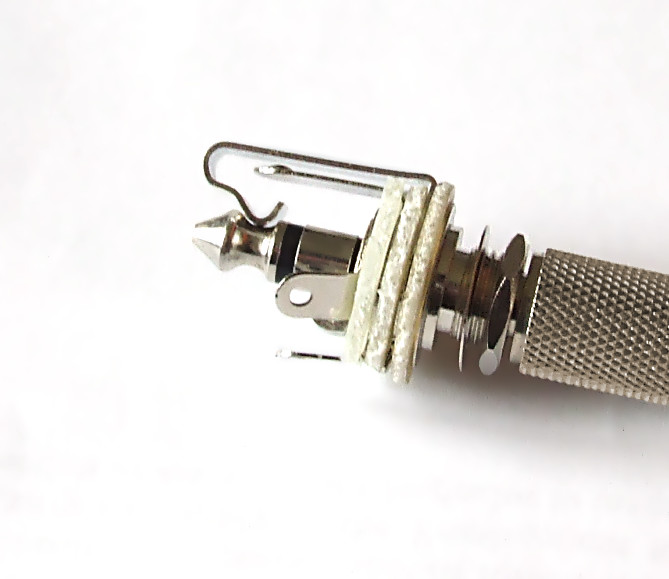
Vintage That Needs to Go Away: Fender, FIX THE STRAT OUTPUT JACK!

 At least once every 2 weeks or so, I have to give a little speech about how a student needs to make sure they keep the nut tightened on the output jack of their Fender What-ever-Caster.

Pure Evil!


 They put a flat washer under the nut, which is useless and obviously does not work.  For the uninitiated:

 The nut works it's way loose as you plug the cable in/out, and move it around.  I'd guess that after 2 months of  use is when they start to loosen, at which point depending how much and how aggressive you plug the cable into and out of your guitar, the two wires soldered to the jack under the jack plate twist around and around..

 Until one breaks, and the guitar stops working.  Sometimes one is near a music store that can repair it.  Sometimes it's maybe only $35 or so to fix, but closer to a standard bench repair fee of $75 is possible.   At least a week will be lost, maybe more.

 That's presuming the student/Stratocaster owner even knows this has happened and CAN be repaired.  How many people just stopped playing guitar because this happened to their Squire Stratocaster after a few months?  What impact does this have to Fender and other brands for people that end up never staying with it and buying more gear?

 This has been a scourge forever.  The "phono jack" is a design left over from literally 1948 or so, and really can be traced to about 1877.  It's primitive, inelegant, and failure prone.

 I can think of a few better ways of doing it, but I don't have money to patent and manufacture such a thing.  Fender, though - there's no excuses.  Why they continue to use this idiotic part is beyond me, aside from it's sheer cheapness.

 They could easily improve it a lot: simply use a serrated washer, or put a dab of Loctite on the nut.  Or both.  Either nobody at Fender has thought of this as an issue and a fix, or they just don't care.

 Until then, I'll continue to have to waste a student's lesson time explaining they need to keep the stupid nut tight, and that the shorting-noise they're hearing is the result of the jack being loose, and that when it fails they've got to get it fixed.  Ridiculous.


Tuesday, November 20, 2018

The Welcome Death of Genres!


The death of guitar? 

 No, ridiculous hype from a few bored writers.

Also, people who based reality on statistics instead of their own common sense: new guitar sales down doesn't mean interest in guitar is also down.  It means new guitar sales are down.  Where is the tracking for used sales?  Particularly sense Reverb.com seems to have really come into its own, and there is no Craigslist tracking, and how about sales of guitars direct from China?

 On the other hand...


 I haven't had a Musical Purist in a long while as a student.


 Most everyone I've taught in the past 5 years will not simply state one genre of music as their preference.  Usually when pressed, it will cross at least one other "traditional" genre.  Everyone today has hybrid tastes.

 Which is a great thing in my opinion.  I've always wanted it this way, it is as it should be; I've never only listened to just one genre.

 On the other hand, most of my life has been ... wrecked... by musicians insisting on a curiously conservative adherence to staying genre specific.  This is still pretty much true today, but - I see it waning.

 Which means it will take a few years, but hopefully I predict by 2022-ish there will be a pop/rock/whatever music renaissance as people finally let go of staying within the traditional confines.  Hopefully this WILL be the death of the worst affliction to music that was initiated unfortunately in the late 80's.  That would be...

Banal extremism and gimmicks as the basic of style.

 Meaning, hopefully no longer will the following adjectives be used in conjunction with music:

  • The fastest.
  • The slowest.
  • The lowest.
  • The highest.
  • The most dense.
  • The most complex.
  • The heaviest.

Additionally, hopefully we'll also see the end of what I tacitly would say is gimmicks.  Techniques that require unorthodox approaches. Either tapping that approaches piano skills, physical/rhythmic tapping that approaches trying to be a percussionist AND a guitarist at the same time, anything that is trying to be what normally would take 2 people to do, playing with other body parts than the fingers, playing backwards, upside down, using another musical instrument at the same time, ...... yeah.  I think that's about it.

 "Hey, can you show me this clown metal song this guy is doing using a waffle iron for a pick, and all of his strings tuned down an octave with piano wire and he's standing on his head underwater while his right hand is playing Chopin on a Korg Microkeyboard silconed inside a zip lock bag, and his feet are hanging out of the pool playing the kick and snare drum parts to a Pantera song?

  Can you show me that....?"

 How about the old-school "genres: returning?  "pop/rock", "country", "classical", "sound track"?

 No appending of the nationality, or geographical region, or era. 

 Just guitar.  You know, just the music.  Here's hoping.


Monday, October 15, 2018

Entertainment Psychology and Practice

I don't use or recommend a book in the context of teaching guitar.

Because ultimately the trick to learning guitar is maximizing what is entertaining about it to you.

In the late 80's during the height of the hair-band metal technical guitar playing era, I could actually prescribe a pretty exact regimen for about a 1/3rd of my students.  They would follow it, and the following week be considerably better at what that regimen addressed.

 They were very, very motivated.  As in, I haven't seen that motivation since then; "people today" (who are standing on my lawn...) can't emulate that motivation, because it was the only time in recent music history where instrumental technique was high prized and actually commercialized.

 Back in that time on MTV - which for all intents and purposes was the entertainment equivalent of the internet for most people in that era - there was a few years where the dominant thing you saw on MTV at any one point in time was guitar-centric rock.  Not only that, but there would be a guitar solo featured heavily in the middle of the video: the guitar player was the star.  Literally.


 Women can't practice to look "as good as" Taylor Swift, men can try to workout to get that Arnold Swarzenegger physique, but it's not going to be the same.

 Guitar solos, on the other hand, was something you can work at and eventually mimic effectively "exactly".  You COULD be the same as the "star" on MTV.  You could walk around knowing you were special, able to do something that was put on a pedestal and respected on a global scale that made you unique.

 That did wonders for my business.  I started teaching in that era, and for many years I never faced the problem of having to figure out how to keep a student motivated.  I completely took it for granted.  I could do what the Famous Guitar Players Did, I could help the student do the same, it was very straightforward and focused.  Just about every student I had played in bands, and that continued for at least a decade into the 90's.

 Then it went away, although the desire to be in a Rock Band remained a pretty good motivating factor.  About half of my students would be in gigging bands, and some went on to making records and touring the planet.

 That went away as the record industry died in the 2000's.  So what remains now is a curious, diffuse mixture of wanting personal growth, a little bit of a rush of doing something special, and maybe a dash of rock stardom swagger thrown in.  But it's rather abstract and non-specific.  Nothing like "I want to get in a band and pull off guitar solos like the guy in (Insert Favorite Band Here)".

  In the year 2018 everyone has different motivations, different musical preferences, different schedules, different expectations, and an overall jadeness to the process of music.  Does "fun" mean a step above the Guitar Hero video game experience?  Is "fun" playing along with a song, or is "fun" being able to execute a single, stand alone piece of music?  Is "fun" having a professional skill set?  Is "fun" learning about how to make music from scratch and record it, or to be able to analyze it by ear?

 Everyone is a unique case these days, and it's super tricky for me as a teacher to prescribe a routine.  In the 80's it was purely a matter of mechanics.  These days it's a matter of trying to get the mechanical side of technique to move along linearly to expectation - which is tricky when the balance of "fun" and "tedium" is a ratio that's different for everybody.

 I insist that ultimately learning skills within the context of goals set by music recordings ultimately is the best way to go about things.  Nobody today is going to "practice" the mechanics of something for very long at all (particularly relative to the 80's) - but being able to get it out of the way while playing to music is easier.

 It's also informative from a rhythmic standpoint.  Doing something properly along with a recording that addresses a particular aspect of one's ability is really the only way to learn the "invisible" aspect of timing.  Learning the mechanics apart from matching it timing wise to the Real Thing is pointless!

 So the Trick is balancing the "practice" routine with what is at least marginally entertaining to you.  Which gets back to "what music do you really like?  Specifically?" and "what do you REALLY want to be able to do on the guitar?".  I'm not Vulcan, I can't read minds, you have to help me out on those questions!  Sometimes I can help the student out on it from a musicology standpoint, but learning to be honest with yourself is a good thing.  Do you *really* want to learn how to play The Currently Popular Song or do you actually like The Almost Unknown Song by One's Favorite but Unpopular Artist?  You'll learn much more within the framework of "what can be learned from that song?" because the entertainment factor will keep you motivated.


Sunday, August 19, 2018

What Pick to Pick?

"What pick should I use?" is maybe a Top-10 question I get.  Which kind of has an easy answer:
"medium".  


Raise of hands: who has seen one of their own guitar picks under an electron microscope...?
 (special thanks to student Dave Burke for the electron microscopy!)


 What does that mean?  I presume the person I'm talking to is going to either be looking at the plethora of plectrums (sorry) at the must store.  In which case (sorry again, geez...) I'm sure there will be the ubiquitous Fender medium celluloid pick.

 I may sometimes suggest someone get a thin pick.  From a string collision standpoint, a thinner pick causes the picking hand/arm the least amount of disturbance and resistance, which makes it easier to maintain a steady rhythm.

 There is a lot more to picks than that, though.

 COMPOSITION


 Basically picks are made either of a cellulosic plastic, which is what most people initially think that a guitar pick is - the Fender style pick material.

 The most popular at this time though, is Tortex.  Tortex is a plastic that once had a trade name called "Zytel" if I'm not mistaken (could be).  This is commonly associate now with the Jim Dunlop brand, and are color-coordinated based on their thicknesses.

 Nylon plastic I believe was popular in the 60's and 70's.  There was a brand called Herco that from my Speculative Anthropology (tm) research was the popular brand at the time.  The Herco style had an embossed sand-paper like texture where one holds the pick.

 The remainder are something of a grab bag of outliers.  There was a time when actual tortoise shell was a thing to use as pick material; the Ultex plastic material is meant to replicate that.  Delrin is a thermoset plastic that has some strange properties that would seem to make it a good pick material, but in my experience they wear at really strange rates, and seem to be a bit "dead" response wise.  There are also horrid cheap plastic picks that you don't want to use, you'll be able to figure that out fairly easily. Hard acrylic/ translucent picks have the down sides of celluloid and break sooner, and usually have "flash" on the edges that feels extra-resistant to smooth rhyhm. There are also steel and copper picks, and the curiosity of the Big Felt Pick that it would seem nobody is absolutely 100% sure about.


A thick human hair is about the width of the scale shown at the bottom.  One would think a bomb went off on the pick; does that mean I have "explosive" picking...?  Hah...


SOUND / KINEMATICS


 I'm going to start with the felt picks.  You'll see these at every music store, yet at every music store I've worked at nobody can really give you a straight answer of what they're for.  Typically you'll get one of 2 answers: they're for ukuleles, or for bass.

 You want a soft sound on ukes.  But back in the the nascent days of the electric bass guitar, the notion of accepting the difference in sound from an upright double bass was not embraced.  The felt pick I believe was originally meant to NOT sound like a pick, but more like fingers.

 Which they do in a way.  The problem is that they immediately start shedding felt and make a mess.  For guitar it's a nice soft sound, but in both cases: I've never, ever encountered anyone using a felt pick. I've only seen someone buying one because I think they're not sure if they should have one or not.  In the studio they can be useful if someone plays bass with a pick but is having problems playing softly, without making a lot of...

PICK ATTACK NOISE


 ..is an integral part of guitar sound.

 The standard celluloid/Fender plastic pick almost instantly gets a microscopically jagged edge that creates a raspy high frequency attack sound.

 The angle one puts on the pick can demphasize that, or enhance it.  For certain types of blues playing, exaggerating it adds an more brilliant and cutting initial sound associated with certain guitar players.

 From a playing stand point I hate them with a passion - they're almost getting worse and worse, more and more jagged, raspier and raspier.  They're effectively snagging on the string.  It's something that takes up a little bit of processing power that I don't want there.  But for some, it's part of "their" sound.

 The biggest downside is that THEY BREAK.  They'll split on the tip when you least expect.  You can use a "heavy", but they will still break.  So, snaggy feel, raspy sound, and they break.  BUT...

 ... they're the only pick that makes a proper pick-slide sound - and it's got to be a "medium" or "light" pick.  So, if you want to do those Tom Scholz Boston long pick slides you have to use one of these.  Because a nylon won't really do it, and a Tortex definitely sounds different and less satisfying.

The Tortex material iss great.  They last an order of magnitude longer than a celluloid pick.  Not only that, but as they wear down they basically sound the same, except as the tip gets more blunted you get a more pronounced attack.  They don't break.  They're superior in all ways, except one - they sound silly doing pick slides.

  Nylon picks are kind of halfway between the Tortex and celluloid.  When new they have the least pick attack noise, very smooth feel on the strings.  As they wear in they get a little bit raspy, a little bit less smooth - but nothing like a celluloid pick.

 They have an additional property of being a little bit softer, which for the thinner varieties means some people actually bend them in their grip.  The super thin Tortex picks will do this as well, but with the nylon it facilitates changing the angle of attack which alters the sound - Tortex has a very wide window of "normal sound", it's hard to make them sound excessively raspy even for effect.

 Nylon picks will break, but it's like guitar strings - you don't need to expect it.

Metal of course lasts the longest.  The problem is that the thinner ones cannot sound soft, and all of them have a specific "tinkly" attack sound that some like, some hate.  The biggest downside is that they quite rapidly destroy the wound strings; and you'll get string shavings all over your guitar and into your pickups, and that can be a big problem.  If you have a string endorsement and a roadie to change them constantly, it's maybe not as big of a problem?  Also know that the copper picks will stain your fingers green, and you're probably absorbing a considerable amount of it.

 Delrin, and the outlier plastics - they're a mish-mash of disadvantages over the above.  The Ultex material has a specifically raspy quality that I presume is what tortoise shell sounds like (I've never used one, thankfully that stopped being a thing in the 70's).  It's kind of like Tortex with the snaggy/rasp of celluloid, but a specific high frequency rasp that is a bit more forgiving than celluloid.  If one likes that scratchy pick attack sound, but doesn't want to bother with learning to manipulate it this would be the pick to get.  It's more forgiving, lasts 10x longer than celluloid.

STONE - pretty self explanatory.  Thicker, scratchier, destroys strings, makes strumming feel weird and playing smoothly a more random event.


 SIZE / SHAPE

 The tip determines the sound.  The stereotypical shape is "neutral" sounding.  You can also get pointier tips, which translates less energy into the string, or blunter (pre-worn out?).  Some people will use the side, the "hip" of the pick either for the sound, or because it seems faster (because of the shallower angle of attack).

 There are also all sorts of goofy things, picks with multiple tips, fanned tips, the oddball Dunlop brand "shark" picks that, again, people can't really explain the why of, and the new trend of really odd thicker-at-the-tip picks that some Obscure Metal guys prefer.

 There was also in the 80's a very strange pick, whose name I don't recall, that was nylon but had a diamond-shaped knob on the tip.  It's purpose was to force you to be hyper-careful, otherwise the pick would snag, literally get hooked up on the string.  It worked if you were patient enough to use it - but redundant if you can make yourself practice picking that carefully in the first place!

  Coins: 2 very famous guys are known for using coins.  Brian May of Queen, the British sixpence.  Billy Gibbons of Z.Z. top, a Mexican peso.  Gibbons stopped using a peso a long time ago I believe, but Brian May used one his entire career.  The serrated edge of some picks make a very exaggerated rasp on the attack (listen to any Queen guitar solo for the characteristic squeak), while the round shape has a very specific loose feel.  You can try using a quarter, but remember it's metal: you'll quickly destroy your wound strings.  Gibbons and May are imbued with the magical Endless Supply of Guitar Strings as well as The Guy That Automatically Just Changes the Strings When Needed on Your Guitars.  Imagine that....

 Size.  There is the "regular" traditional Fender/Herco shape.  There is the smaller "Dunlop Jazz II/III" size, usually with a pointy tip.  There is the Oddball 3 Sided Triangle that is awful but apparently popular as "bass picks" in the 70's; maybe for cavemen players that would break celluloid picks so fast they preferred having the convenience of "3 picks in one" over the completely anti-ergonomic shape, and weird string feel?  There are some picks with thicker areas where you hold them, holes in the middle.


It's interesting how the edge has these "gigantic" clumps of abraded material.  I'd guess this is what goes away with the "carpet smoothing trick"?  (Again, thanks to Dave Burke for the electron microscopy!  It's great knowing visually what something *feels* like, and it's interesting how it matches how I imagined it!)


 I presently use a medium-ish nylon regular sized pick, which I get in bulk from China.  I prefer something like an .88mm (medium-ish) Tortex in the "jumbo jazz" size/shape (which means a pointy tip but regular size).  The "jazz", pointy tip makes a thicker pick sound like a thinner pick - less attack - if you can control it, and raspier like a celluloid pick if you rotate it slightly.  If you grip tighter it makes the attack more pronounced, which is good when you play "fast" for note definition - if you want that.  I'd prefer a pointy tip in nylon if there was such a thing, and cheap.  I use the nylon picks as a compromise, because they're relatively cheap: when they start getting worn down I'm not in a mind set of  "I can still use this pick, I can't waste".  I ditch them before they get to the "might split" phase.

 I propose a pick with a Tortex jazz-tip encased in celluloid.  As the celluloid rapidly wears away the Tortex pick is "unveiled"; but if you wanted the "scritchy" celluloid sound you'd still have it by digging the pick in deeper or rotating onto what was still there of the celluloid.  It wouldn't break and would still be usable even as the celluloid wore away.  I'm not sure if celluloid plastic can be bonded to Zytel, though... hmm, I need to email a friend in N.C. that is a plastics engineer?

 There are always fingers, and for some reason today I'm getting more people that want to insist on using just their fingers.  Which makes sense if you're going to EXCLUSIVELY play nylon string guitars and classical music.  Otherwise - you've got to use a pick!


I spotted a virion instantly in this image; my germ radar is well tuned, but I guess not enough hand sanitizer that day..?


Wednesday, October 25, 2017

Music is a LANGUAGE; theory is SCIENCE!

 Music is a language, theory is science. Seems very simple to me, but in reality the misuse of syntax has put a pox on becoming a musician historically.  I'm a heretic, but I can explain myself.


 In my experience as a guitar teacher most people consider "music theory" to be something like a set of rules.  Alternatively, a set of instructions.

 This is partially true, but ONLY within one context:

 To become a classical music composer in the historical style of Bach.

  More specifically, I'd say it's an obtuse scripting language that yields "classical music" when a data set is applied. Another way of putting is, your whim is the data set and if you follow the ascribed rules and instructions, the output will be classical music. Which is fine, if you live in the 1700's, perhaps in Austria.  Some people virtually do, and have a wardrobe of frilly shirts to show for it.

 Sorry to digress into Viking metal.

 People I teach view the intellectual side of learning music to be something they can digest in a month or two, maybe even a few weeks.

 Would they think the same about learning Spanish?  Chinese?

 You're learning labels for subjective human musical experience. 

 Grammar doesn't inform you as to what to say.  It doesn't tell you how to describe what a flower looks like.  You have to have something to say.  Theoretically you don't need to know it, but you'll be limited in communicating.

 You don't have to follow grammar (obviously in the 21st century...).  Grammar allows you to communicate in a traditionally acceptable format.  When you decide to break from grammar, you tend to fall into idiomatic styles.

 You also are subject to being inadvertently comical.
 
  Music as a language is no different.  Music "grammar", when ignored means chances are you'll end up playing in an idiomatic style, and you'll also possibly risk being a cliche.

 Ignore it and you mind end up whimsically playing circus music passages, out of tune, or out of key.  Comical.

 Learning music as a language..... 


is a more appropriate description of what a person does when deciding to pick up an instrument than "reading the instruction manual" or "going over the rules".  I know a lot of people view it as something akin to math.  I also can hear a lot of people doing it as a math process.


   There are grammar, vocabulary, and literature aspects to it. 

How you form a sentence (melody).  What style of phrasing (vocabulary).  What stylistic antecedents you draw from (literature).

   You can watch a video that tells you that "dogs don't drive cars" in order to not know that "Bob the Labrador drove his Tesla to Kroger" is probably not a sensible sentence.  It's not a practical way of learning how to communicate, unless you want to be deliberately comical.  Yet, this is how many/most people think or expects the process of making music to work.  "Thou shalt not play parallel 5ths" is an adage in classical music, yet you'd be hard pressed to write a rock and roll song treating that as a rule or instruction.  

 Instead you use your "literary" experience, what you have listened to and love, as a filter for what you create.  Non-metaphysically you're using your subconscious awareness, the parallel processing ability of a human mind, to effectively handle the math behind the scenes.  That doesn't mean the process isn't super technical, maybe the most technical process humans do; but it is empirical observation that each human makes through experience being utilized that creates good music, not algorithms. 
 That an algorithm can make a result that sounds like music, does not consequently mean that is how all music or arbitrarily good music is made.  Human subjectivity trounces that approach, despite being abstruse and indeterminate.
 Learn music as a language, not a science.  This is maybe the most important difference among musicians in my opinion.  This should not be construed as simply some homily like "play from your soul, man" or some such; it is a very self-introspective awareness of how one does the process.


..... Learn music as a language, not a science.


Monday, January 11, 2016

David Bowie: Scary Elegance as Art

 
(note: this may not seem to be typical "guitar lesson content", but actually it is....)  


I saw - saw - David Bowie for the first time as a co-headliner with Nine Inch Nails. 
It was a very clever show, one of the most brilliant ideas I’ve seen. As his set progressed, Trent Reznor came onstage to sing with Bowie. Then another song, but one of Bowie’s band would leave, then one of Reznor’s would come onstage.
This progressed until it was Nine Inch Nails, but with Bowie singing Reznor’s songs. Bowie bows out, and it’s just Nine Inch Nails. 
Very clever, completely dispenses with standard operating procedure at a concert. Executed flawlessly, in a very naturally evolving way. That his music could flow so seamlessly into Reznor’s is a testament to his oeuvre. Bowie’s music spanning my entire lifetime, through a “set” that documented how he stayed on top of trends, and set trends, all the way up to the Modern Era. 
What I remember most from the experience is how captivating a presence he was in reality. Everyone knows of his theatrical delivery, combined with kinesthetic/dance motifs. Veritably Madonna before Madonna, always changing his “look and feel” in brilliant and novel ways. 
But live, a few feet in front of you, it’s different. There is an X factor at play. Things come across that a camera does not resolutely pickup, that lens distortion and depth of field conspire to obscure. 
He did a cross section of his characters that night, Thin White to Ziggy. His facial musculature as he sang, it’s composure, for each song was different. The timing of how his brow fell on a sentence, the tension in the cheek muscles. His posture made his clothes fall in a very particular way, and depending on the character, it might be perfectly still, or unsteady. Very subtle movements you can’t see on television. 
The net effect was two things. One, “this person is completely committed to this character”. Not evidenced by a coarse stage acting of the raising of the eyebrows, but in the gravitas of the tension - or lack of - in the facial muscle movements. On the movie screen, you get a hint of this on a tight closeup with a narrow lens with some star actors.  Though as part of that you don’t see the poise of the person. It’s not the same effect. 
When it’s in front of you, it’s extremely compelling; like an exotic animal, it’s art. This guy stalked around the stage as different personas for an hour, for each song, illustrated a different “animal”, a blend of effects he physically created. This was educational for me, because you read anecdotes from people talking about the “physical presence” of a famous or historical person, and you think it’s hyperbole - it’s not. Some people on the planet have what I might call an “extroverted kinesthetic high I.Q.”, and awareness of what their physicality is conveying in conjunction with being able to manipulate it for effect. When people talk about Bill Clinton’s “personal charisma”, or Elvis’ “charm” - as if it’s something you don’t know, they’re saying it because they realize perhaps it really is something you don’t know. 
Just like having a high musical I.Q., or verbal intelligence, I think this can be a phenomena that is a top-percentile bracket that one just does not commonly experience. In turn, being aware of such a thing could be completely off your radar. 
In this sense I think seeing Bowie live is actually something akin to seeing history in front of you: a rare, unique individual. I can imagine how someone with this subtle control of personal affect could become famous in other ways, for better or worse. He used it to maximal effect for art. 
Two (yes, I remember I wrote “two things”) - that character-induced effort to control facial musculature was having an impact on his vocal delivery. 
It sounds silly, but when you talk with a smile on your face you sound different, even if you think you are being neutral in your delivery, than if you frown. With Bowie, jutting out the angle of his chin, holding it there, or holding a sideways frown - while singing imparted a subtlety to the sound of the delivery. It yielded the conviction required to sell the character. It imbued color and character. Something that is mostly lacking in 21st century vocal delivery, with it’s perfectly-mediocre, staid execution. 
I’m not the biggest Bowie fan, apart from a handful of songs I like greatly. I thought his show would be interesting, but I did not expect captivating. Something akin to enjoying watching Nicholson flip out, or Walken simply be “Walken”, except in 3D in front of you; but with much more potency than is conveyed through secondary media.
It makes me wonder what it’s like to see someone like a De Niro, Dustin Hoffman, 6 feet in front of you in real life portraying a character. Is it a similar potency, that while diluted through a lens still comes across? A thought I would not have pondered prior to seeing - literally - David Bowie.