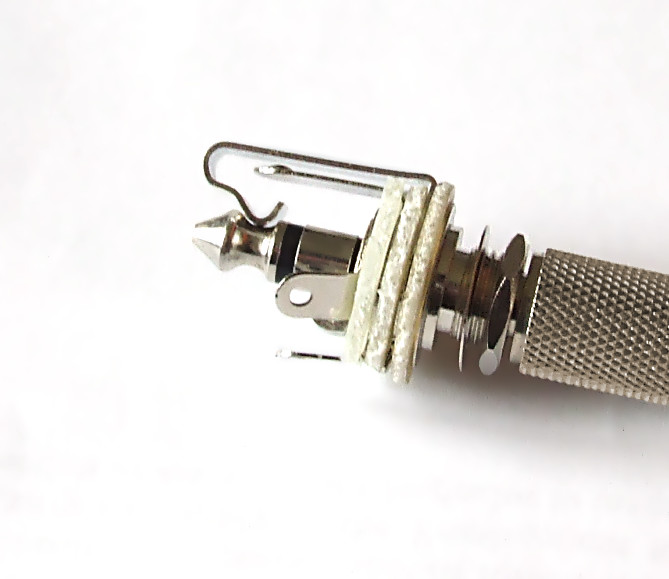
At least once every 2 weeks or so, I have to give a little speech about how a student needs to make sure they keep the nut tightened on the output jack of their Fender What-ever-Caster.
Pure Evil!
They put a flat washer under the nut, which is useless and obviously does not work. For the uninitiated:
The nut works it's way loose as you plug the cable in/out, and move it around. I'd guess that after 2 months of use is when they start to loosen, at which point depending how much and how aggressive you plug the cable into and out of your guitar, the two wires soldered to the jack under the jack plate twist around and around..
Until one breaks, and the guitar stops working. Sometimes one is near a music store that can repair it. Sometimes it's maybe only $35 or so to fix, but closer to a standard bench repair fee of $75 is possible. At least a week will be lost, maybe more.
That's presuming the student/Stratocaster owner even knows this has happened and CAN be repaired. How many people just stopped playing guitar because this happened to their Squire Stratocaster after a few months? What impact does this have to Fender and other brands for people that end up never staying with it and buying more gear?
This has been a scourge forever. The "phono jack" is a design left over from literally 1948 or so, and really can be traced to about 1877. It's primitive, inelegant, and failure prone.
I can think of a few better ways of doing it, but I don't have money to patent and manufacture such a thing. Fender, though - there's no excuses. Why they continue to use this idiotic part is beyond me, aside from it's sheer cheapness.
They could easily improve it a lot: simply use a serrated washer, or put a dab of Loctite on the nut. Or both. Either nobody at Fender has thought of this as an issue and a fix, or they just don't care.
Until then, I'll continue to have to waste a student's lesson time explaining they need to keep the stupid nut tight, and that the shorting-noise they're hearing is the result of the jack being loose, and that when it fails they've got to get it fixed. Ridiculous.
After examining many videos of the literally hundreds of guitar factories in China, and seeing thousands of guitars stacked in each, I wonder "where do they all go...?"
My '82 Japanese made Squier Strat bought used in the 80s. "Entry level" in 1982, now "vintage-quality".
Obviously somewhere, the world is a big place. There are countless "developing country" export markets. But I'm going to limit this discussion to "here" in the U.S..
I've referenced "peak guitar" previously, but not in this context. Solid body guitars have been built routinely en masse since the mid-1930s. I don't have production numbers, but let's say the "modern era" began with the Stratocaster in 1954.
There has never been a "guitar shortage" relative to demand. So consider that demand was met every year since 1954. Almost 65 years of consumer demand met. That doesn't mean it was 1:1, and exact number built relative to demand, obviously there would be an overrun every year, but let's ignore that.
Another way of looking at that is that since the population has drastically shot up, and demand for guitars has been more or less a constant thing,
Relative to 1954 64X consumer demand has been built (at least). In other words, there are at least 64x as many guitars floating around today than in 1954.
Yes, I know: all guitars don't make it to retirement behind a glass case in some Yakuza's mansion in Japan one day like a '58 'burst Les Paul. But I would argue that the surplus not sold greatly outweighs those given to have been "broken", or "lost" somehow to the aether. In general, there is a t LEAST 64 times as many guitars in the universe today than demand wanted in 1954.
Population in the U.S. in 1954 was about 150 million. Today it's estimated to be between 350-400 million. A bit more than 2-3x as much, let's say 3x. Then, let's say that half of the guitars sold in the U.S. have evaporated into thin air somehow, leaving a 32 year production run versus 1954.
In this imaginary context let's equate 400 million people today to then, 3X as many. 3 1954's to one 2018. You still have over 25 years at least of guitars sold beyond human demand today. These days a million guitars or so a year are sold in the U.S. alone. But let's say it's half that, not as many sold in the 60's as now.
That would yield at least 10 million guitars in a category of "still exists, was wanted by somebody as "consumer demand" at some point". That's obviously not all the guitars built or sold in the U.S.. Just a very conservative number of "how many viable guitars are there in the wild, in the personal possession of someone in the U.S.". I'd say it's much higher, but let's say it's 10 million. What does that number mean? It's not exact, it's not even clear what it entails aside from the claim that at any given time floating about I'd say there are at least than many guitars "in circulation". At least. I think it's something of a buffer figure: for the 1.5 million sold every year in the U.S., there was probably something like 10 million to be had, easily, used I'm guessing.
I don't know how many used guitars are sold on Craig's List, Ebay or Reverb.com. But I'll step out on a limb and say that there must be at least .... 30-40 million viable guitars around in the U.S., if not more. I'm going to say 50 million.
I'd like to think that means around 15% of the population plays guitar. I think it could be higher than that. I think for the past 10 years we've seen the guitar replace the piano as "the instrument every child has to learn as part of being a well rounded individual, learning a musical instrument". Cheaper and more portable than a piano, a certainly more relevant these days and motivating. But it wouldn't be every single child in the U.S.? On the other hand, the amount of people aging that do play guitar I would claim is increasing year by year for the same reason. Gen-X and younger, we were the transition era from piano to guitar as the Instrument our Parents Wanted Us To Be Able To Play. What am I getting at with all of this?
Solid body electric guitars in general, don't vanish. All of the above aside, there is 50+ years of electric guitars around somewhere. They *accumulate*. And while the "nice" ones accumulate value, most don't.
And with 50 years worth of guitars - millions - my question is, "how many more guitars are there in the U.S. relative to consumer demand?". I think a whopping amount more. Go on Craig's List, plenty of nice guitars being sold. Unfortunately, everybody seems to want almost what they paid for their instrument .... ... The gist being this:
At some point it will be Common Consumer Awareness that "guitars are everywhere!". In reality one should get around half new value for used gear; this will become self evident at some point, and the used guitar prices will reflect this. What is presently maybe a 10:1 margin will grow.
In other words, it will become Common Knowledge that you can get a Perfectly Good Electric Guitar for half price, relatively easily, used. As it stands now, just about everybody knows somebody with an unused guitar in a corner of someone's house, somewhere. At some juncture it will be just "the thing", Prices for cheap guitars used will be even less than half - at some point worthless as people realize....
guitars are everywhere.
What does that mean for guitar retail.....?
China is building guitars faster than I can type this sentence. At some point "soon" low-end guitar sales will fall flat, because of the above phenomenon. China is speeding the demise by pushing this inevitability closer, flooding the market with hyper-cheap and quite decent guitars. At some point in the future (presuming there is one...) - maybe 3-5 years from now, music retail will have to reckon with what will be seen as a "sudden loss of demand for guitars". It will be dramatically, and ignorantly touted as something along the lines of "guitar losing popularity?" when in reality it will just mean we've met Peak Guitar and the concurrently present population will just be finding guitars to start on in other places.
In reality it could be a boon; more people will try guitar because "guitars are just laying around everywhere". More people may end up being life-long players, and in turn buying better gear as they progress.
... but it's going to be hyper-annoying to read/hear people talking about guitar retail tanking, and hard for the remaining brick-and-mortar stores.
It was the year 2017. Music retail was in ruins and rumor of the demise of the guitar was rampant.
The Corporate Empire had decimated music as art. Small groups of rebels called "guitar players" scattered across the planet still maintained the Order of Guitar, while practicing "music".
Despite being reduced in numbers, they unconsciously sought the rebirth of the Era of the Guitar Player......
Everything recorded today sounds "good". It's hard to find a really bad sounding recording, and believe it or not there was a time when that was possible. Recording gear used to be astronomically expensive, and in turn people who knew how to use it were like acoustic Jedi, a rare and almost legendarily mysterious group.
Everybody now has access to equipment capable of making a Professional Sounding Recording.
Let me point out something I think people are missing "these days":
The word RECORDING.
In reality, today the word should probably be "Professional Sounding Creation".
Recording implies a certain documentary aspect that no longer applies. You're no longer "capturing" a Crazy Rock and Roll Band in the wild of the recording studio. You're making a sound creation. Which is fine, it's what I spend most of my time doing, despite the paucity of public release. But bear with me Anonymous Reader, and consider the following:
There was a magical time between say 1950 and 1980-ish when everything was recorded with perfectly vintage gear!
Everything.
While recording technology has all but been perfected, the last holdout of Sound Creation is the mythical "great guitar sound". Everyone kind of knows how to get it: use the same light sabers that were used by the Jedi.
The ironyshould not be lost on the reader that while everyone has some sort of semi-professional recording device and capability today, most do not possess the things required to create the signal source to make a professional sound.
In 1972, it was by default you had a tube amplifier. And probably a non-wacked out pickup configuration on your guitar. Even if you didn't have a Marshall or a Fender, it was probably a tube amp you played through.
I would bet that while guitar players at the time were very concerned about sustain, beyond that it was a more abstract thing as to what good "tone" was. Ironically again, it kind of didn't matter since everyone had the necessary components to get one.
Which meant that "rock guitar sound" was a tube amp turned up. That's about all. In turn all of the weird varieties of tube amps, guitars and speakers plus microphones and studios yielded a lot of Great Guitar Sounds back then.
More importantly, great but diverse sounds. Not-homogenized.
Today most guitar players are super obsessed and hung up with not getting a "good guitar sound", but getting someone else's sound.
I will digress and say that most guitar players are not equipped with the mental apparatus or technical acumen to really fathom that idea. People will cite their favorite guitar player, but said guitar player's recorded sounds can differ greatly, using a lot of different combinations, not to mention recording techniques.
That being said, they still gravitate towards Holy Grail ideals already established, and go to extraordinary lengths to buy exactly the Right Thing to get it. Except it's a red herring. Most of these ideals were serendipity.
In the 60's and 70's, everyone wasn't trying to get an exact sound someone else had.
Brian May, Jimmy Page, VanHalen, Randy Rhoads, Eric Clapton, none of these have sounds like the other. Despite a lot of gear overlap.
The reason I'm writing this is that I'm having a nostalgia-dive through the Eric Carmen/Raspberries catalog, and there is this song:
Not something I want to listen to, but the guitar sound on the intro is "pretty cool". Almost kinda pre-Van Halen Van Halen.
There are freebies there for the era: a Marshall, or a Bassman, or "?"? I don't know. But it's probably turned up to get that distortion, and the mic was probably not right on the speaker and in a 70's Storyk flat-dry, UNCOLORED sounding room. And a plate reverb. Vintage gear.
It's not that it was SPECIFICALLY magical gear, just that it was obviously of the era, turned up and recorded with period gear. It doesn't sound EXACTLY like Van Halen, and vice versa.
Which is good. Blast it, as a guitar teacher, I am soooo tired of hearing the Perfect Metal Guitar Sound Variation #76778. There was a time when the band SOUND was supposed to be unique, and was prized.
Now it's the opposite, there are pedestals.
Consider the following songs by Joe Walsh:
Walk Away
Funk 49
Rocky Mountain Way
All 3 are GREAT FRAKKING GUITAR SOUNDS. And all 3 do not sound like the other.
Consider the following songs by Billy Gibbons:
Lagrange
Tush
Nationwide
All 3 are GREAT FRAKKING GUITAR SOUNDS. And all 3 do not sound like the other.
Consider (insert favorite New Metal Band Songs)
1
2
3
"Great" sounds? The last Great Unique Metal Sound was Dimebag's solid state Randall's IMO. Those recordings sounded like "those recordings". Past that recording we have nth number of super saturated Metallica Black album variations, all interchangeable.
Brian May hits one chord, and you know it's Sir Brian May. That can't be said for anyone "new" IMO.
You Retro Vintage Music People: I'm looking at you. You're not excused. You buy the gear, but then you want to set it just like Your Hero. You never get there, because half the sound is the recording process. But that's ok, you're having fun I suppose.
Here's what you're doing wrong:
You're not using your gear like people used your gear when it was brand new.
It's not turned up to 10. Yeah, it sucks, it's loud, and now sound engineers get to dictate what you do. But if you spent a ton of money on a vintage amp, and you run it on 2, it probably sounds ok. It does NOT sound like a band in the 70's, or early 80's. You're fooling yourself.
I sold my vintage amps. Because it wasn't practical to run them at levels that might damage them for what they cost. I could put them in a closet, or in my case a complete other building to deal with the volume. But I couldn't justify running a vintage 1968 Marshall at levels where the transformer might let go.
..and see, unlike a vintage guitar circuitry doesn't get better with age. It just gets different, weird of malfunctioning.
So I have a New Tube Amp solution. It's very much not a "traditional vintage" replicant. I'm not concerned about that, just as the guy on the Raspberrie's recording wasn't worried about the pedigree of the tubes in his amp.
Those sounds from the 70's recordings were easy. They were not all Van Halen approved Marshalls, or Stevie Ray Vaughn approved Supers/whatever. Keith Richards wasn't worried about not sounding like SRV while deciding he liked Ampegs, or whatever. But in reality, anything "old Marshall like" with real Celestion greenbacks, or alnico speakers, with the right mic and recording chain is going to be good. Not unique but good. Any tube amp is going to sound good with those speakers.
Or even with the "wrong" speakers. Kudos to Derek Trucks for using car radio speakers. Bravery in action. A unique and great sound.
But seriously, one should go back and listen to those old 70's hard rock recordings; they don't all sound the same, but they all sound mostly great from a guitar standpoint. Not bland, not generic. What a concept...
The number one problem I see is that the input jacks on Strats go bad. The nut comes loose, the jack itself twists around, and ultimately breaks a wire going to it, or the component itself.
Fender is a funny company. They've sold untold thousands of that classic model guitar, and it's seemingly infinite variations. Which is why I find it remarkably ironic - and dumb - they don't take the initiative to fix something they have to know is broke!
It can't be because they're "preserving a classic design" - because frak knows they've changed it enough times. I can think of many simple ways they could easily fix the situation in tooling, and while it might seem expensive to make a completely "new" part, it would be smart:
they would set a precendent in the industry, that is besotted with countless uses of that same dumb design;
it would be an obvious improvement pros would recognize;
it would prevent the syndrome of a beginner guitarist, having purchased or been given one of their cheaper models from basically quitting because "the guitar is broke" (and likewise, not buying anymore Fender products)
it would prevent people like myself, guitar teachers, from having to explain why their $120 cheapo Strat needs maybe a $50 bench fee to resolder a wire on a $.10 part.
I know I will be explaining this to many people in the future. It won't make sense to them. It's like GM using the same bolt for a common auto part since 1956, that always works loose and breaks, and never fixing it. For the longivity of a company that manufactures something for retail, that may not be a good idea from a QC perspective.