Monday, August 29, 2022
Yet Another Kit Guitar Problem #1

Monday, August 15, 2022
Yet Another Kit Guitar?

That's my story and I'm sticking to it...
Monday, August 8, 2022
Artificial Intelligence / Machine Learning in Guitar Sims is NOT "Amp Moddeling"

Tuesday, August 2, 2022
10,000 Steps To Playing Guitar?
Friday, July 29, 2022
On Machine Learning and A.I. Technology Used for Guitar Modeling
The problem with sims to this point is that:
- Syntax - people using generic terms, or misusing terms
- Apples and oranges - comparing different technologies
- Non-linear vs. snapshot comparisons.
Making an IR that sounds identical to a *static* IR is straight forward, but also Occam's Razor invoking. "Why does it sound identical... sometimes?"
Algorithmic approaches feel better, and *seem* realistic but *not identical*. I can adjust my playing to sort of mimic the Real Thing, but "like a real amp" is not the same thing as "just like a real amp". I love Bandmasters because of the variety of timbre you can get from pick attack, dynamics; you can fake that with Certain Emulations, but it's not as subtle and controllable. I have to exaggerate and worse, think about doing it.
That's no fun.
And speaker IRs are only as good as the engineer that made them, what mic and where they put it on what speaker through what preamp at what level. A greenback sounds different cranked; if you play soft it acts completely different, sounds different. Again, there are ways around that, but it's a kludge and it requires conscious effort.
You can make it work "like a real amp", but not *just* like a real amp.
That's not fun.
All of these things I believe can be fixed, but I'm not sure if the programming talent and effort is in the right place, or guided suitably. They're all almost good, suitable for "most applications", but not exactly the same across all applications.
I think the *curation* at companies has been the most important thing until now, the success of some and the downfall of others. ML/a.i. may make it moot, but the "curation" of the training will still be a factor in the end result production-wise. The end result may be fully convincing, but not in the production style desired, which might be a new problem.
/ $.10
Monday, July 25, 2022
What Guitar Should I Buy (redux)
If you can spend around $250, it's easy. There are 3 "brands" that immediately come to mind, and surprisingly they're not "the expected names".
Monoprice - who is now selling for the same price through Amazon as through their own website. Yes, the HDMI cable company! Their $110 "strat" clone is probably the most cost effective starter guitar there has been. Manufacturing quality is good, potentially a gig-quality guitar.
Harley Benton - a British mail order brand that is available through the Thomann U.S. website. A bit finicky to locate and order, but this line of guitars are well thought out an "curated" clones of popular guitar models. Maybe a bit more expensive than the Monoprice, and a bit longer to have shipped, but with more variety is you choose to study specifically what you want.
EART - Available on Amazon, you can consider these "upscale cost effective".
That's it. You don't have to have an amp with an electric guitar, you can still hear it unplugged. You can also find little rinky-dink $20 amplifiers on Amazon or Ebay if you hunt for them, although alternately you can no doubt find a used practice/starter/beginner amp on Craigslist or at a pawnshop in the $50 range. How's that for brevity?
Thursday, July 21, 2022
The Golden Age of Guitar Consumerism
"... when I was your age, we put chicken wire strung on nails on a rotten 2 x 4 and called it a "guitar", and darn it, we liked it!!!"
Guitars have never been more affordable. That's not the same thing as "cheaper" - technically you could buy guitars at one time for $20 from a Sears and Roebuck catalog - but it wasn't very playable.
 |
| Inside of a $200 Chinese "generic dreadnaught acoustic" |
There have been different eras in "Guitar Affordability":
POST LUTE:
In this era, at the dawn of the creation of "guitar", you only had the choice of getting a handmade guitar. The relative cost, and quality, can't be quantified, but undoubtably it was more expensive than now. Strings were made out of animal guts....
POST INDUSTRIALIZATION:
Guitars that were manufactured, albeit by hand. The dawn of companies like Martin, Gibson. Relative cost depended on quality again, and given that steel strings started around the very early 1900s, people still often substituted "other found wire" because of cost considerations. "Acceptable action" was probably "not acceptable" by today's standards, something to keep in mind when listening to early wire recordings.
POST JAPAN/KOREA INDUSTRIALIZATION:
The beginning of machine fabrication on a large scale. This is where China is now, except they've got modern machines/tools. Early examples were pretty crude, but playable (and now coveted by masochistically deranged "Cheap Retro Guitar" collectors...) Later, some of these guitars were pretty good, good enough to make Gibson sue Ibanez because they were making functional Les Paul copies. They would still go for around $200+, adjusted for inflation many more hundreds. The cheap Asian guitars could be found for around $100, $50 in a pawn shop - but the reader must keep in mind that's in 70's/80's dollars. While the Ibanez guitars approached "modern quality and playability", in general these were not guitars one would want to buy today.
From the mid-80s onward Japan took over and invented the "modern high quality cheap guitar". Ibanez, Tokai, Fender Squire (Fuji Gen Gaki) set a new bar. Korea entered this field with Westone/Electra, Hondo branded guitars, a forgotten transition-period brand that got lost in the coming Ibanez storm.
This is when I started playing guitar. 5 years earlier, and my beginner choices would have been dismal. At the time in the mid 80s, my only choice was made by a company called Hondo, which is effectively what is now known as the Korean Samick brand. These were not as good as Ibanez, but not as crummy and unplayable as earlier Asian guitars. Hondo was "the" beginner guitar for a few years until Ibanez steam rolled the field, requiring Fender to step up with the Squier brand.
POST 80s IBANEZ/SAMICK DOMINATION - THE CHINESE JUGGERNAUT:
I can remember when China first came on my radar as a guitar builder around .... 2002? I started to see various corporate-labeled cheap lines with "Made In China" stickers, and they seemed pretty ok. But they really stepped it up I think around 2010, and as predicted, were going for a transition from OEM to their own branding. It was obvious they would do that, and while they're not "technically" branding guitars today, it's now a known phenomenon that "China can make good guitars".
POST ALIEXPRESS AMAZON ERA:
Now. China has so subtly maneuvered into dominating the guitar market that it's like they've done shades of marketing. Very quickly from selling clone guitars on Aliexpress - while being OEM for many brands - to "somehow" being used as OEM for alternate brands (Monoprice), and *winning* by making a better product.
Now there are the Monoprice guitars, EART, Harley Benton, et al - and they're good guitars, and less than what used to be the equivalent entry level guitar. While being as good as what used to be a "mid level" guitar, or even higher.
What you can get on Amazon for $200 from one of these brands now is astounding to me. Somewhat of what would be considered an "upper tier" guitar in the 80's. EART and Harley Benton both offer stainless frets, roasted necks and bodies, great hardware/bridges/tuners, good pickups, and they come set up pretty good as well.
When Ibanez had to start offering guitars made outside of Japan, that was a watershed moment. Maybe Samick, who has massive production facilities in Korea, can hang on? Hard to know during the covid pandemic, with production being dependent on the health of a lot of workers (note China *does not mess around with trying to knock down covid outbreaks...). Indonesia has tried to enter this battleground, but they've tried to scale against an already optimized market.
NEXT LEVEL - POST PRODUCTION?
There isn't a next level. China is at diminishing returns production wise. But here is "the next level" that nobody has considered:
1) Guitars don't evaporate. They go in a corner, in a closet, under a bed, but they don't go away.
2) at this point there are probably enough used guitars on the planet that there is probably a positive ratio of them relative to people that even think for a moment they want to play guitar. Everyone knows more than one person that plays guitar; I'd even suggest "most families" have a guitar at their disposal.
3) China has relied on manufacturing *growth*. The situation with guitar is what I'd think is maybe the penultimate last frontier. They'll have to go after the car market next (which they are... and the U.S. and EU governments will let them crush our own manufacturers with imports...). But after that, they're at diminishing reeturns GDP. Solar will still continue to grow, but as efficiencies go up they'll hit a ceiling pretty quickly in 5 years (particularly as demand scales up due to international energy costs/infrastructure problems).
The $200 guitar is almost at a point where one can *objectively* say "that's as good as a manufactured guitar can get". Meanwhile, if you count how many hundreds of millions of guitars have been made to this date, someone really wanting to learn to play guitar can probably ask around and find someone willing to lend them a guitar, or even have one. A parent today is likely to have one I'd suggest.
Wednesday, July 6, 2022
Approaching the Uncanny Valley of Guitar Playing
I've written elsewhere about how a.i./machine learning is going to completely change the musician landscape, as far as production is concerned.
People do not realize the leap forward we're at right now. I won't rehash what is available elsewhere, except to say "it's probably not what you imagine it to be". What is happening with Pytorch/Magenta/Deep Mind etc. is as big as the Internet was, and will change us and our lives as much as it has.
I recently tried the Magenta project's plugin. The sax version is amazing; it does what I promised would one day happen with ML/a.i. software, in that it doesn't just make the input come out having the timbral sound of "a saxophone", but also the inflections.
To the reader: if you think what I'm talking about is akin to playing a synthesizer with a saxophone patch, you're wrong. It is a completely different thing. The program is doing things the developers literally don't totally understand; it is working on a pure dataset level. It is NOT a DSP based wave shaping technology.
It's a bit tricky to handle. I have to imagine saxophone playing to match the dynamics, attack and vibrato - but when you get it right it's uncanny. I wish the violin version worked as well, it's very creatively liberating: as far as I'm concerned, I can add a "tenor sax" part to a recording.
I presume there will be a guitar equivalent soon. You'll be able to whistle and have it come out with an inflected guitar sound. The question is in the quality of the model training (that governs the output); as I predicted, soon it will be possible to make a training model create an output that "corrects" a player's dynamics and inflection to sound equivalent to "Stevie Ray Vaughn", "Brian May", etc...
Unlike the saxophone, though, the variety of guitar sounds I think will make it impossible to have it be flexible enough to cover "all" styles. And using it will pigeonhole your choices into a certain way of playing, just as the "saxophone" plugin does. You can't "play" the saxophone plugin like guitar, and have a good result.
So in the future - people will specialize in how they operate with their ML sounds - after a period of people getting confused/impressed by the realization of the technology actually working. A period equivalent to "keyboard popped octave bass sample basslines", and then a maturity.
One downside is that it will making mocking up a cliche clone of a Known Famous Song very easy, and many will do it and garner kudos for it. The confusing effect of this is going to be a big negative.
Another potential negative is - a company will jump on this to have it in a guitar amp. I've been saying this for awhile: a beginner amp with this technology can have a couple of presets that will not only yield an output that sounds just like the original recording of a Famous Player, but correct dynamics and probably pitch as well. Harmony will be a problem I think for a few years, but "lead guitar playing" is about to undergo a disaster in that people will think even less of the skillset required to ACTUALLY DO A GUITAR SOLO.
A renaissance mentality will maybe become a trendy thing, hopefully.
Monday, June 13, 2022
More Golf to Guitar Analogies
You can putt from 3 inches away with a consistency equivalent to Tiger.
You can't play the whole game the same.
But you can find things on guitar that are "3 inches away" that are easily doable, and rewarding. A problem I see a lot these days are people watching YouTube and getting the impression that what "learning guitar" is about is the equivalent of mastering golf on a PGA level.
And it only taking a year or so.
Instead, there are aspects that are equivalent to putting, driving, getting out of sand traps. There is the basic skill set, "learning to swing", which might be akin to playing open chords properly. Changing between open chords is a fundamental skill that is completely overlooked by most - but the foundation of the skills required to do everything is set by what happens with the "simple" "cowboy chords".
Driving, maybe the endurance to complete a song. It's difficult for me to get someone to work on a song to completion; I can't provide what is really self-motivation, only bolster. For kids, learning songs has a competitive aspect, wanting to know more than Timmy down the street does. Later on it's not a lot different, there is still something of a pecking order when adults get together to jam. But for someone not at that point starting out, it you're not surrounded by friends playing the motivation can be tough to want to practice a song to the end.
Putting might be akin to the finesse required for soloing. But again - a very short putt can be accomplished by just about anybody, and likewise there are very simple "solo bits" people can learn that can lead to making a longer and longer putt. But getting the satisfaction of the ball going in the hole initially has to be present. Again what I see a lot of people do these days is expect to make a 20 foot putt over and over, and to "practice" by driving at it frantically a few times and getting mad.
Getting out of sand traps: specialty movement. There are particular, "kinesthetically fun" things to learn that are unique physical things to play. Learning to navigate them - get out of the trouble they seemingly put your hands in - is rewarding. You can feel like you physically accomplished something in a specific way.
I do think these analogies make golf enthusiasts particularly prepared for learning to play guitar, but hopefully the analogies can flick a switch on for others as to how to *approach* learning to play guitar.
Monday, June 6, 2022
2022 NAMM Show Guitars
I did not go this year. So all of this is theoretically anecdotal, but...
It looks like manufacturers are entering a state of frustration. Lots of wild colors - it would seem they're almost touching on revisiting some of the visual tropes of the mid-80s: lots of turqoise, purple, magenta.
And from Ernie Ball, the Kaizan - a crazy angular guitar that would have been seen in the early 80s in New Wave videos? The secondary "private company" guitars displayed also appear to be touching on the same aesthetically garish traits of the 80s, leaning on geometrical basics instead of French curve based shapes.
Then there is the "signature" problem. There was a time when I went through a phase of using the infamous Dunlop Jazz III pick, a tiny red nylon design with a pointy tip. Then one day it became the "Eric Johnson signature pick". Eric wasn't the first to use those picks, and I'm not endorsing Eric, so I though it a good time to try something else.
Likewise, I'm definitely not paying $$$$ for a guitar with somebody else's name on it, unless it's Leo Fender, John Suhr, PRS or Tom Anderson. All of which are now making a lot of "Joe Blow Model" guitars. No, I don't want somebody else's idea about what a guitar should be, and I don't want to see or even know their name is affiliated with the guitar I'm holding. No offense to said players. At least the Jeff Gordon model Gibson Les Paul hasn't been brought back?
But overall it seems/feels like they're all in a mode of "we've got to do SOMETHING new/different", when in reality they don't. It's like web pages that become popular - MySpace, Digg, Reddit, Facebook, etc., that want to "improve the experience" endlessly when in reality they have maybe reached a moment of sartori in optimization for the user. For some of those web sites their "new, improved" versions turned off their user base and they went under.
For Fender, Gibson - they really need to just calm down, par down what they offer. Try to be leaner, cheaper, and more consistent so that when someone says "go buy a Strat/Les Paul" it doesn't take an hour to explain which one. And certainly don't come out with something that looks like an attachment to an old Cadillac, or a Gundam.
Tuesday, May 31, 2022
Mountain Biking Ain't Like Dusting Crops (but May Be Like Playing Guitar?)
I think there is an analogy to be made between the phenomenon of what gets YouTube clicks in mountain biking, and playing guitar.
 |
| The author "sending it" |
Having been into BMX semi-seriously for many years as a kid - at the end I had converted my half-pipe skateboard ramp into a BMX-capable quarter pipe, a good 8' tall rickety Ramp 'O Injuries. I suppose this was around the age of 14-15, and I'd soon have a car and then, become a Guitarist. 1983-84.
I started mountain biking in, I think, 1992. I wanted to ride bikes for recreation again, but something less serious (and dangerous) than BMX. Twice a week I'd take my respectable $500 non-suspension MTB a few miles out of town to ride a few trails in the area.
It was FUN.
The only concept to "mountain biking" back then was, ride a bike on trails in the woods. You could still spend money on making your bike lighter, which made it easier to get up hills (mountain biking USED to be about going UP hills as well as down...), maneuver around Minor Obstacles.
It started becoming mainstream popular around about 1994. Some musician friends got into it, and we'd go riding as a group sometimes.
It was FUN.
Then, people started getting more serious about it. You had to "huck" off of drops; you had to HAMMER a trail as fast as possible. Otherwise, you were lame and a squid.
Suddenly, these concepts - you were either RACING or being EXTREME and RAD - overtook the premise of simply riding a bike in the woods. The more "casual riding" people I rode with found reasons not to go riding anymore.
Then, the mountain bike industry realized (like used guitars...) bikes last a fairly long time. So, they came up with propaganda to sell more bikes:
You HAD to have a full suspension bike (not really), you HAD to have expensive and finicky (and dangerous) clipless pedals, and the 26" wheel standard - a BIG wheel I thought coming from 20" BMX bikes - was declared OLD and RETRO.
You now HAD to have 27.5" wheels, which meant a new bike.
Then, they told you that you must have 29" wheels. Another new bike. THEN, tubeless tires: effectively no inner tube (very uncool...), glued-on tires. A big pain to maintain, expensive.
Meanwhile, hucking off of things turned into 10'+ drops, 10-20' gap jumps, things that previously were considered reserved for sponsored pros.
YouTube happened. Suddenly "mountain biking" on YouTube became endless videos of RAD dudes and dudettes, going very fast downhill on $10,000 bikes, clearing professional motocross scale jumps and drops.
You don't really see the people crashing and going to the hospital. Just lots of bright and shiny people being RAD. Are you rad? If you can't hang with this seen obviously you're not!
Do you even really ride mountain bikes? How much does your bike cost? You've never been to Whistler Colorado? Never cleared a 25' gap? Squid. You suck. Your bike costs less than $5,000? Poser.
I don't see many people riding mountain bikes for FUN anymore. Not in the numbers I saw in the 90s, not by far. I'm quite sure between the MANDATORY gear upgrades and the necessity to SEND IT, DUDE as fast and recklessly as possible, most people are turned off. It's all you see on YouTube as "mountain biking".
Guitar playing is almost exactly the same in a relative way. But you're older...
You start out for yourself, it's fun. Some friends might play, or decide to play. BUT....
You start watching YouTube and see what appears to be "everybody" playing guitar on a professional level, and often combined with Distinctively Bewildering Insights being conveyed.
I think right now, YouTube is "disincentivizing" the motivation to play guitar for similar reasons that I think mountain biking. The mystery and self-discovery is removed.
Sitting on your sofa, instead of getting on your bike and actually riding a trail yourself, is NOT MOUNTAIN BIKING. Nor is watching a video of someone playing guitar. You are missing the best, and most important element that is really down to the fundamental concept of BEING. You're making a withdrawal from The Bank of Motivation, without any way of making a deposit later to up the value of your savings.
Monday, May 16, 2022
The Educational Value of the First 3 Dave Matthews Band Records
I find myself revisiting the Dave Matthews catalog, as I have a acoustic guitar student that needs a bit of a challenge in a specific area: 16th note rhythms.
Without delving into the more repetitive funk catalog - with the likes of Chic, Ohio Players, James Brown et al, it escaped me for a bit to think of something the student could reference that wouldn't be too repetitive (although that wouldn't be a bad thing).

The 2000s!
The first 3 Dave Matthews Band records/cds are very unique. They feature very busy, guitar intensive themes in a pop music setting. Something that I don't know of having happened before or since.
There have been other high marks "guitar lesson era wise", but I would say a couple were even dependent upon being ancestral to the DMB era. I would tentatively suggest Jack Johnson's popularity resides in echoing some of the pseudo-funk rhythms of DMB, and maybe Jason Mraz benefitted from DMB popularity as well. Early John Mayer I would argue relied a lot on superficially sonically having many of the same ingredients at the pinnacle of the DMB era. Years beyond, in a more deprecatory way Ed Sheeran perhaps benefitted: it now seems like there has to always be a "present default acoustic-singer artist" where there hadn't been one since the songwriter era of the 70s.
Because it was pop music - very popular music, as in for a few years maybe a 1/3rd of my clientele was motivated to learn Dave Matthews Band songs - the average nascent guitar player had a fairly high bar set for them, but also the reward factor was very high.
The perceived social popularity of "playing guitar" has a magical, invisible effect. Motivation is mostly determined by it I've found; and motivation elevates. The "average skill" level during what I think of as "the Dave Matthews era" was a peak only matched by when I started teaching back in the late 80's during the Hair Metal Era.
The biggest thing was 16th note right hand subdivision, followed by strumming and single note combinations being such an integral part of DMB songs. Effectively in "high gear" technique wise, it allowed a lot of students to transition to other things. I'd go as far as to say from this era a particular local artist sprung to being a national success, which lead to other things - but I digress.
16th note right hand parts;
Articulate single note lines;
Overall uptempo phrasing;
Prerequisite partial/full bar chord fingerings -
Leeds the novice Dave Matthews Band fan to many other things, because the variety of the above allows for more options than a lower bar.
Sunday, May 1, 2022
Musical Narcissists?
I recently saw somewhere that there are people that want to take a revisionist approach to music history. More specifically, in regards to the venerable Yamaha DX7 keyboard, that they were "never cool".

There are certain DX7 patches/sounds that I like, but there are a lot I hate, that were overused IMO during the 80s. The reason they were overused, though, is because THEY WERE COOL. I would suggest we're in a transitory phase for the DX7 where it's becoming "classic", but not classic enough in the sense that people have decided to base songs around them again.
There were keyboards originally marketed for a certain kind of music: the Hammond organ, Farfisa, Rhodes, etc. that were used in a "cool" context at the time, but then re-entered creative music use later. The Hammond sound - a "church organ" - evoked a certain thing, maybe "what you hear in church", "what my parents like", until it faded out and then came back in a different context.
Now it's just "a Hammond sound". Which can be found in all genres of music, and doesn't imply a specific era anymore. I think the DX7 is about to become a similar thing, the "uncool now" connotations fading to become another classic.
BUT, I made a post on a message board about the concept of "Musical Narcissism". Something I've seen many, many times: thinking one's perspective is magically "cool" enough to say another's is not, despite evidence to the contrary. I don't care for disco, but it was definitely a cool thing in the mid-70s; likewise, there are a lot of disco references in modern pop music; it's faded away long enough to now be a "classic" sound choice.
Below is the quick blathering post I made on the topic:
"
It was very cool at the time.
People that want to say something isn't cool that was once in style - bell bottom jeans, horn rimmed glasses, gated reverb, whatever - are the musical equivalent of being narcissistic. They think their subjective opinion is an empirical scale that is always ascending, when just about everything can be a parabola.
One either feels cognitive dissonance when revisiting an old place, because the context around it has changed - or they reject reality as it once was.
If one wasn't around when the DX7 happened, then saying it was "never cool" is musical narcissism: they're ignoring reality while not realizing people *see* them ignoring reality.
I *don't like* the DX7 sound in a modern context, BUT - I *can* imagine it being popular again if recontexturalized. The sound of the 80s carried a lot of tropes with it simultaneously, which makes it easy to mock (or dislike), but those things can be used in a fresh way individually (tinkly DX7 patches, rhythmically timed non-linear reverb, Yamaha or Linn drum machine sounds, etc.).
If anything, the DX7 lends itself to... overtly cheery sounds, fey pads, which is not my taste but a lot of people definitely liked. I wish I had a "DX7 remover", along with a "non-linear reverb" remover - which could happen with ML/GAN trickery."
Tuesday, April 12, 2022
Golfers Make Good Guitar Students?
The Augusta National has just passed in my hometown.
.jpg) |
| Golf equivalent of a perfectly preserved 1968 Marshall plexi |
Which makes this post a bit late, but now that I'm "here", I'd like to say:
Golfers make for good guitar students!
They usually have a more humble attitude towards expectations upon starting. Perhaps because you're always humbled playing golf, but it's good to know where the target is, but not to expect to reach it next week. Or next month. Or next year. Golfers seem to have a better grasp on the long view.
Which is good for playing and making music. Reflexive immediacy, expecting things NOW has wrecked modern society: nothing worth doing is easy. Music has been devalued monetarily, but it still plays a role in the daily lives of most everybody; it's a significant thing that takes time to learn as a skill, craft, and to create.
Golfers also seem to have a good awareness of practice concepts. There isn't one overriding method in golf, many approaches to honing skills, and in different aspects. Which of course translates to learning to play the guitar. Some people try to "learn" to play guitar the way some people play Putt Putt: just wack the ball hard and it will hopefully bounce off some things, maybe a clown and an orange barrier, and somehow careen into the hole.
Which is comical, but as I'm writing that I'm realizing there is profound truth in that. If you watch people play Putt Putt/miniature golf, some just can't help but to just randomly "wack" the ball. It's a waste of time, but they can't help themselves. Why are they bothering to do an activity in such a ridiculous fashion?
Because it worked one time!
They got a crazy dopamine kick off of it, and tied to the "success" the feedback loop created means they try to recreate the moment again... and again... and again. They're not getting better, they're not increasing their skills, they're not scoring - they're wasting time.
Maybe a complete novice somewhere got a hole in one first time out playing real golf. But probably not....
On guitar, it's similarly deceptive as the miniature golf accidental hole in one, AND more involved than the real golf hole in one. But the same feedback loop applies: the novice accidentally knocks out something they didn't expect. Maybe for the first time they play something that sounds "pro", or recognizable.
They get that reinforcing dopamine kick. Which is good! It should act as impetus to play more! But unfortunately - and I think this is a byproduct of 21st century society - that experience is interpreted as "I did that easy, it took little effort; I can do it again, recreate this experience endlessly, with the same effortless ease!".
Furthermore, what wrecks the new student is seeing a gazillion people on Youtube seemingly pulling things off with effortless ease!
As a guitar teach I see this phenomenon in a lot of people, and it's difficult to combat. It's an unseen aspect of teaching guitar that is tenuous, hopefully I'm able to help people with that. Watching Youtube certainly doesn't help, it's creating a negative feedback loop as described above, whether people realize it or not.
Golfers realize watching doesn't make them better, they know pretty clearly they have to DO, they have to practice/play as much as possible.
"But that's not fun!" some will say.
That's the problem: not realizing the value in what you're doing. It should be perceived as a lot of fun. You're learning to do something that only a tiny, tiny portion of the population of the whole planet can do. Unlike golf, something in every day life for everybody, almost a constant. It should be thought of as "I'm at Amen Corner, and I just made a chip shot in a situation Tiger Woods did". Except in golf, you can't replicate that experience without being a member of the Augusta National and have extraordinary golf skills.
On the other hand, you *can* replicate a phrase Brian May played in Bohemian Rhapsody, or a riff Billy Gibbons played. Without leaving your house, and you can show your buddies you can do it, and you can build on millions of such examples the rest of your life.
But you're probably never going to make a hole in one in Augusta. Knowing that creates a good attitude towards learning to play an instrument.
Monday, April 4, 2022
Another New York Times Piece on Guitar?
This time an oblique swipe at guitar solos.

It's curious that they seem to like to write articles implying "this thing I'm writing about, heh heh heh, we all know is passe.... but *I* know what cool about it, I'm be self-referentially cool by telling you".
"It's easy to dismiss the guitar solo as an outdate, macho institution"
Pretty much the Rolling Stone formula of non-musicians being critical of POPULAR musician's choices. It's an inclusive trick: because you're reading their article, you're included in their Hip Circle.
Meanwhile I'm trundling along giving guitar lessons, in which wanting to learn to play solos is anything but dead.
Monday, March 28, 2022
Should You Boycott Harley Benton?
So some guys on YouTube say you should boycott Harley Benton because the guitar at the top is a rip off of the guitar below it:
 |
| Harley Benton Nylon NT |
 |
| Taylor TZ |
At least, I think these are the 2 guitars in question?
Which is the gist of my post here: they are similar, but not exact - despite hyperbole.
Many differences: knobs, fingerboard extension, sound holes are different, body size/geometry different, bridge different. They look similar (unless I've got the wrong guitars?), but it's variations on a theme.
A theme that Taylor didn't invent. The first thing I think of when I see both is a combination of the following:
 |
| Godin MultiAc |
..and:
 |
| Ovation Adamas |
 |
| Rickenbacker 360 |
The aesthetic is a combination of established elements. From a design intellectual property standpoint, there is nothing new. From a functional standpoint there isn't, either.
Nobody is buying the $400 guitar thinking it's a Taylor. But more importantly - and this is the real point - Taylor isn't losing any customers for it's $2,200 guitar.
Nobody is walking into a Taylor dealership, thinking they want the Taylor and then settling for the Harley Benton. Nobody. Just like nobody walks into a Fender dealership wanting to order a Custom Shop Stratocaster, and then settles for a Harley Benton strat.
Which is a whole lot closer aesthetically and functionally than the Harley Benton and the Taylor.
Unless one wants to restart the stratocaster clone wars and go off on a jihad against everybody that makes a strat style guitar, the Taylor vs. Harley Benton issue is a non-issue in my opinion. The guys in the Youtube video sells both Fender and PRS: do they want you to boycott PRS Silversky models.......?
Tuesday, March 22, 2022
Tube Shortage Hype Part 2
It looks like Mike Matthews has gotten around the Russian sanctions somehow? That story seems a bit obfuscated, in that it's not *Russia* imposing the sanctions - as the stories I've seen tell?
However, digging through Chinese websites reveals a number of "small" companies claiming to be producing tubes. As well as selling *Russian* tubes, which leads me to posit:
You probably can get Russian tubes through a Chinese source on Aliexpress. China is still doing business with Russia; and while the prices aren't cheap, I would suspect some of the older "established" shops are fencing tubes from the Tesla plant.
It also looks like the Pjvane plant in China has acquired the Changsa Shuguang tooling? So again, I think in a few months once the backlog shakes out there will be more stable sources.
Monday, March 14, 2022
Is the Amplifier Tube Shortage Hype?
Much is being made about the Coming Tube Apocalypse: that sanctions on Russia means "it's going to be impossible to get vacuum tubes soon!".
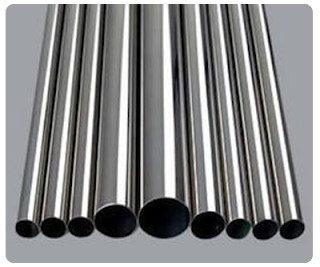 |
| Tubes. |
From what I understand a number of tube specialist companies have already run out of stock. As well as a couple of amp companies.
The problems is.... as far as I know there are only 2 tube manufacturing facilities in Russia. One is owned by Mike Matthews / Electro Harmonix. I believe EH rebrands their tubes for a lot of "names", Sovtek, TungSol, Svetlana, Mullard. In turn I would expect these to disappear.
But JJ makes tubes in Slovakia, which as far as I know has no export restrictions. I see JJ tubes more often than anything else; and China has a few plants that have been making OEM tubes forever. There is no reason these will go away. Furthermore, there was a time not too long ago there were much fewer plants producing new tubes than what we have now, without the Russian sources.
So I'm not afraid that tubes are going away. There is a run on tubes right now, and people have marked up the prices accordingly. Thought they've marked up a lot, it looks like you can still get sub-$20 12ax7 preamp tubes on Aliexpress right now - close to $12 if you buy in bulk. Shuguang, some claiming to be Russian NOS. Not graded, but they're there.
What I expect to happen is that once China notices (probably via metrics on Aliexpress and Amazon drop shipping), as they always do, ramp up production to take over the market. There will be $12 12ax7s again, and reasonably priced EL34s, 6L6s and 6v6s again by the end of the year.
BUT - there will be people making money off of the "scarcity". Guitar amp companies, even amp repair guys, have stocks of tubes. in fact, it used to be you'd see them sort of casual brag about it, "oh yeah, I buy boxes and boxes of them". They won't be running out of tubes, but they'll no doubt charge accordingly. I would think this *shouldn't* affect amp prices on the lower end, because companies like Fender and Marshall have bought pallets of tubes before this came up, and aren't picking over them like a boutique company would. And the boutique makers in general have equivalent supplies.
I suspect the Larger Boutique manufacturers, though, will get a bit of a margin boost. Or not. If China doesn't step up and we get an OPEC like tube supply chain, then I think they'll end up shooting themselves in the foot: as new generations of guitarists happen, the desire for tube amps over modelers wane. This will just hasten making actual tube amps more marginal.
Monday, March 7, 2022
Acoustic Guitar Purchasing Dilemmas (circa 2022)
As a general rule, I think for most people the following made sense for the past 20+ years:
Buy your first "introductory" guitar. One takes a chance here, because it's probably not going to be very playable or sound nice. This is usually without advice from me, and usually takes the form of a guitar that comes in a "pack" deal, somewhere in the $100-150 ball park.
What I'd advise then would be a "compromise" guitar. Something better than the above, but not a "real" acoustic guitar. The advice would be to get the nicest possible with a solid spruce top, with consideration for a pickup system. Epiphone and Seagull/LasSiDo has been a good choice in this category, .
Then, I would advise to try not to buy another UNTIL one could afford either a Martin D28, or a 600-700 series Taylor. Because - in between you're either paying for cosmetics, or another compromise, and these 2 are effectively where "professional, standard issue" acoustic guitars start. But the main reason was - and I've been saying this for decades now -
"there will come a time when it will basically be impossible for you to consider buying a Martin D28. Try to get one now if you can".
For a long time $1,000 was the Magical Professional Price Point. The "nice" guitars started there, or from another perspective, that was how much a Les Paul or D28 would cost. In the late 90s D28s started creeping up in price; by the 2000s it was going up about $100 a year.
A D28 now costs $3,000. While my perspective may be skewed - my income from teaching guitar has lagged inflation, effectively flat for my whole life, I can no longer advise someone to stretch their second-guitar budget to a D28. Those days are over; trying to stretch $600,700 or even $800 to that Previously Magical $1,000 landmark was a tough ask, but $3,000 is ridiculous.
Meanwhile, from what I've seen the sub <$500 price point has gotten better. EXCEPT:
- Manufacturing quality is sort of all over the place;
- Traditional woods are harder to find.
Which is why my advice is somewhat more ambiguous now:
Try to get a solid SPRUCE top guitar first and foremost. The Seagull brand is a cut above quality wise IMO; a less traditional choice of cedar for a top, buy probably a better deal if you're looking to get a guitar to actually use in public.
Secondly, instead of trying to stretch to get a D28 or Taylor/"?" equivalent,
Try to find a guitar made of the traditional woods: spruce top; mahogany neck; rosewood or ebony fingerboard; mahogany or rosewood back/sides. Because this is the formula for what you're used to hearing on recordings as a "standard acoustic guitar". Scarcity is forcing manufacturers to substitute other woods, some working better than others.
What that means is that getting around that $1,000 mark means there are a couple of Epiphone, Yamaha models, and Seagulls that meet that bill. Those manufacturers still exhibit a fair standard of quality; you're effectively purchasing an "off brand Martin". They don't have the name cachet, but effectively speaking are still fine guitars.
Because where my advice once was "there will be a time when you won't be able to buy a Martin D28", I'm now stating "there will be a time when you can't buy an acoustic guitar made of the traditional acoustic guitar woods".
$.10, YMMV.
Monday, January 31, 2022
Chip is Short... Yeah, but.. No, the Chip Shortage
A student told me original Boss DS-1 pedals are going for hundreds of dollars on Reverb.
So I had to look, it seems ridiculous. The DS-1 is probably the most ubiquitous, generic distortion pedal there is, at one point I received one as a bonus for buying something else that was only a couple hundred dollars itself; I never used it, but now I've got to go rummage around in the shed to see if I still have it.
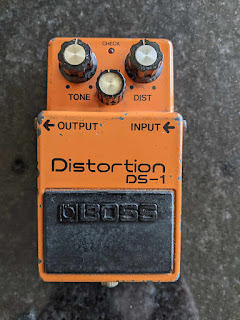
The chip shortage is having a knock-on effect on other things in the guitar gear realm. The chip in the original DS-1 has gone out of production, and it has nothing to do with the headline news story about the actual "chip shortage". A lot of integrated chips have gone out of production before the situation occurred with the factory fire + global shut down "chip shortage", but wasn't the cause of any run on pedals except with the Ibanez TS-808 Tube Screamer variants.
The subtlety of the 4558 variations that were used in Tube Screamers (and clones) are ultra-cork sniffery. I've got .... 4 Tube Screamers/variations with one inside, and there would be no way I could tell if the chip was a "vintage" one or not, there are too many ancillary things going on with them in the circuit design. People compare what they say is "identical" pedals, but they haven't examined the resistor values, the input impedance, what things have drifted out of spec within a "vintage" pedal. It's not actually empirical, and yet, it's still so close that nobody will hear the difference except the cork sniffer doing the A/B test.
I guess I need to go see if I can find the pedal. I think they're ok, good all-purpose distortion pedals that will get someone by in just about any stylistic situation if need be. They tend to make everything sound similar, which could be a good or bad thing. For me, the nature of the way they compress combined with the eq makes me play things I start hearing as "Steve Vai", so I don't use them. That very thing makes them good for "fast technical playing" IMO for that reason, they help you out so to speak, in that they even out your single note playing really well while maintaining articulation. But to my ears it's Steve's sound, so I look elsewhere.
"Chip, in the 21st century a USED Boss DS-1 will sell for hundreds of dollars" - I don't know if I would have believed that 30 years ago!